Design a spacecraft. Fly the mission. Answer the signal.
NASA Space Apps Challenge 2026 · Space Mission Design Game
🔭 Team Hubble Huddle📍 Singapore▶ saket-vanga.github.io/astronova
1 / 7
The team and the challenge
Team Hubble Huddle
Saket Reddy Vanga
Golla Naishika
Pulkit Kayal
Arnav Masiragani
Supriya Prashant Sutar
Arunkumar Kavin Selvan
Challenge: Space Mission Design Game
Real missions juggle science goals, mass, power, budget, communications and orbits. For most students those trade-offs stay abstract. We built a game where you plan, build and fly a whole mission and see how every choice shapes the result.
ASTRONOVA
2 / 7
The idea
A fading signal from an icy moon
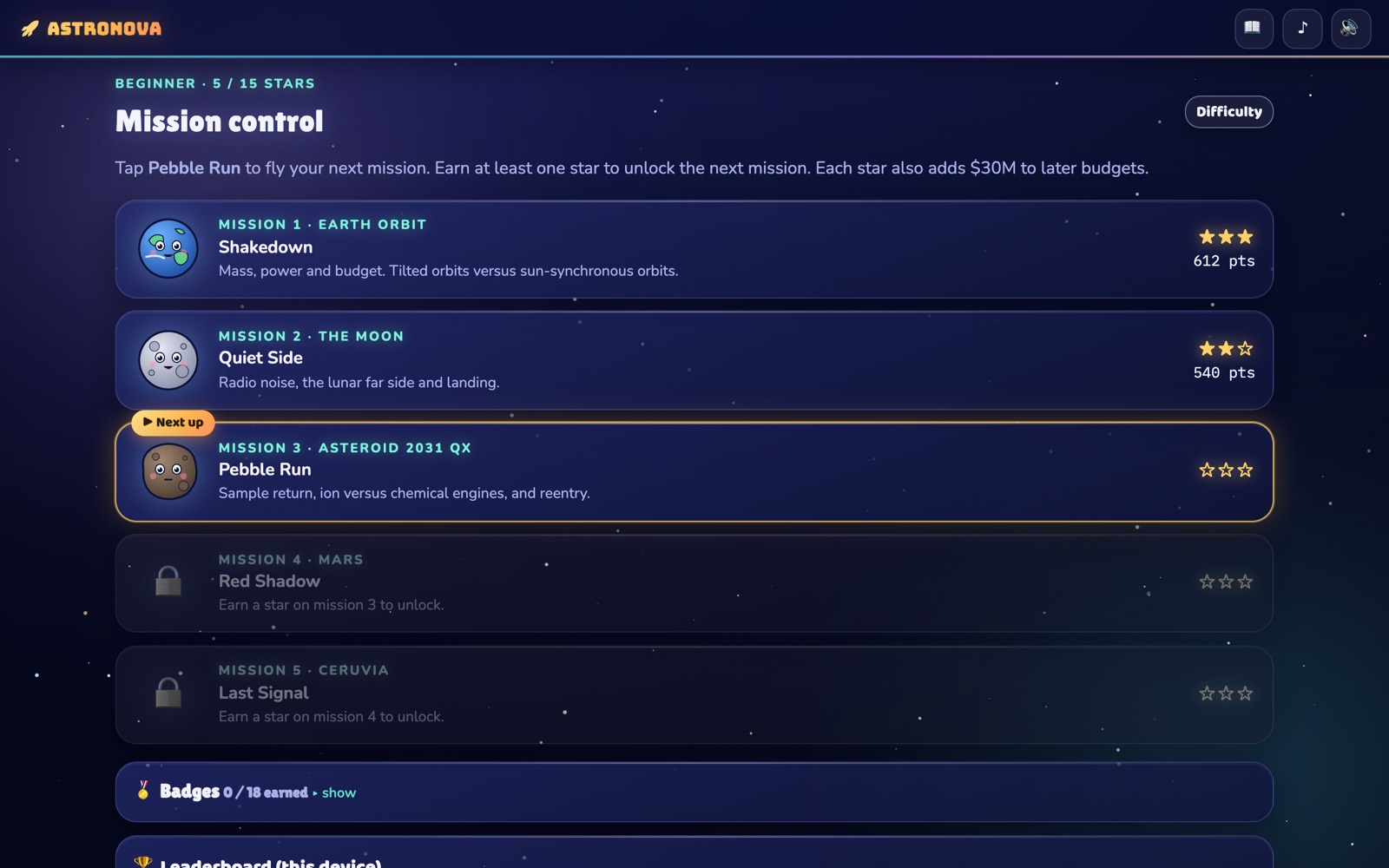
A radio pulse is coming from Ceruvia, 1.4 billion km away. To earn the trip, your team flies five missions, each teaching a new idea.
🌍 Earth orbitmass, power, budget
🌕 The Moonfar side, landing
🪨 Asteroidsample return
🔴 Marsdust storms, RTGs
🧊 Ceruviaeverything at once
- No single right answer: a heavy design works with a bigger rocket, a cheap one with a slower route.
- Beginner mode is very hard to fail; Flight Director is a real challenge.
- Runs in any browser, on phones too. No install, no account.
ASTRONOVA
3 / 7
How it works
Plan it like a real mission team
1 · Science goalCML 1–2
2 · DesignCML 3 trade space
3 · ReviewCML 4 point design
4 · Flyoperations
5 · Reportlessons learned
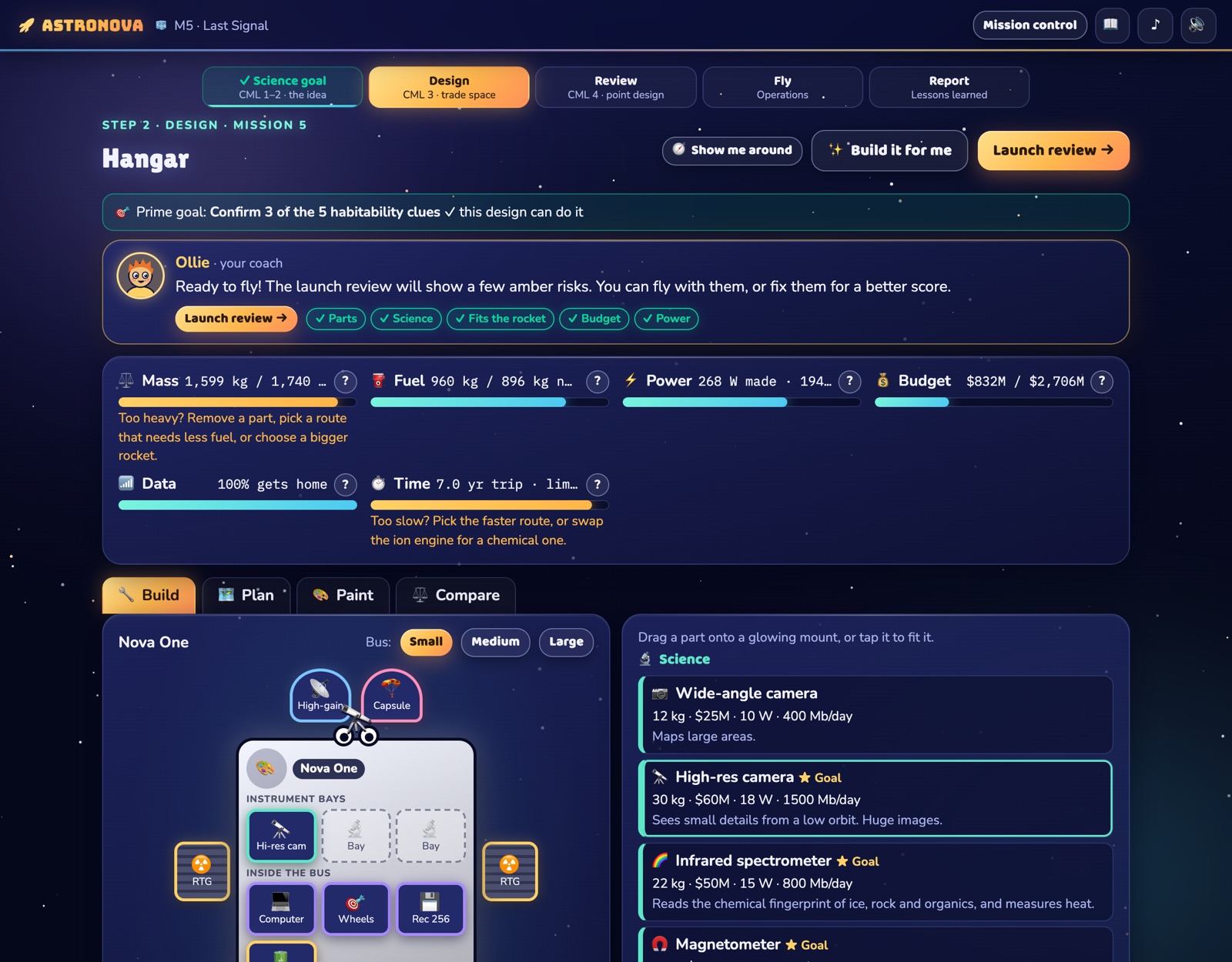
Hangar: 32 parts, 6 live meters (mass, fuel, power, budget, data, time) and Ollie the coach.
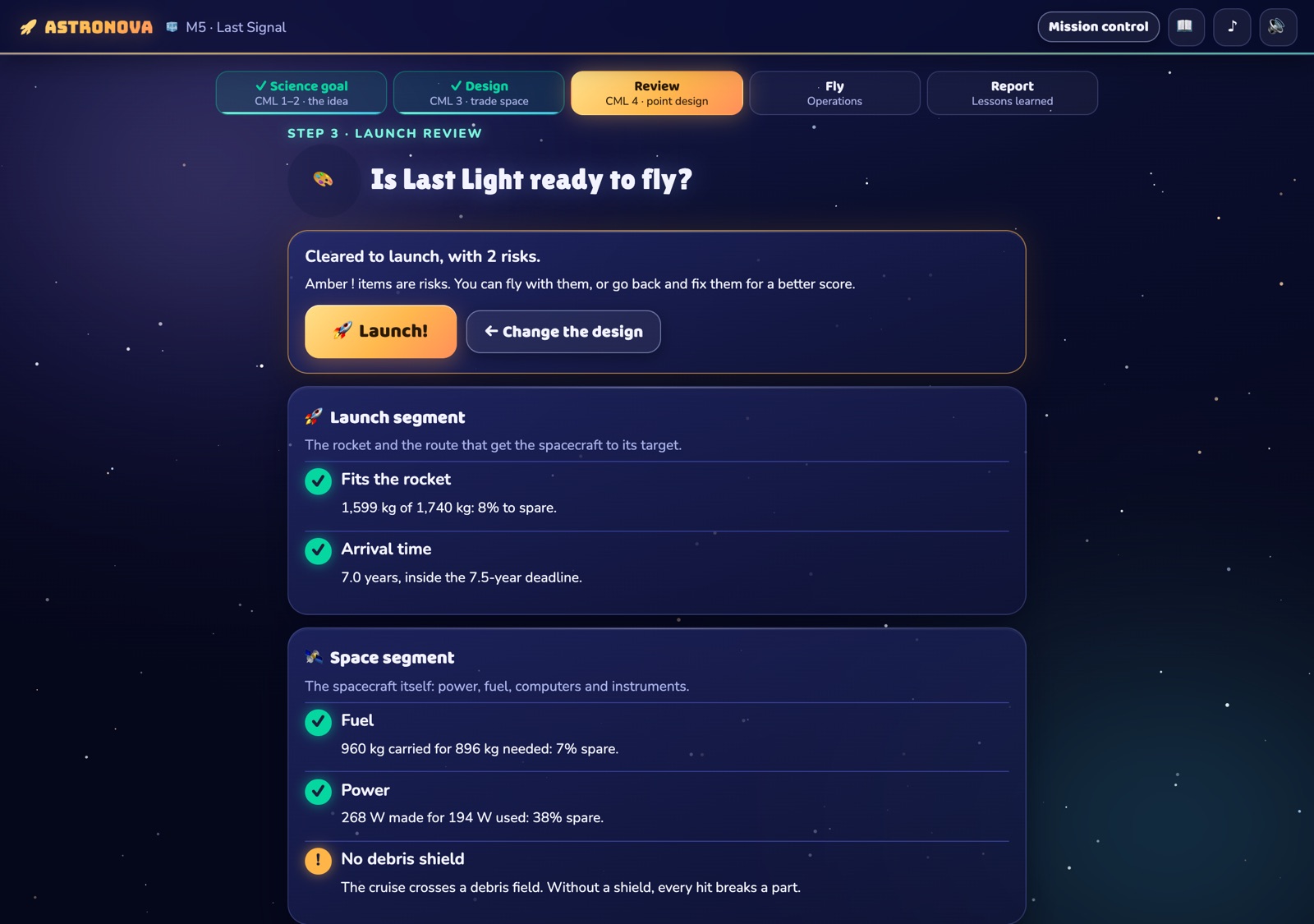
Launch review: checks grouped into launch, space, ground and user segments.
ASTRONOVA
4 / 7
Fly it, then do the science
Six flight minigames, real consequences
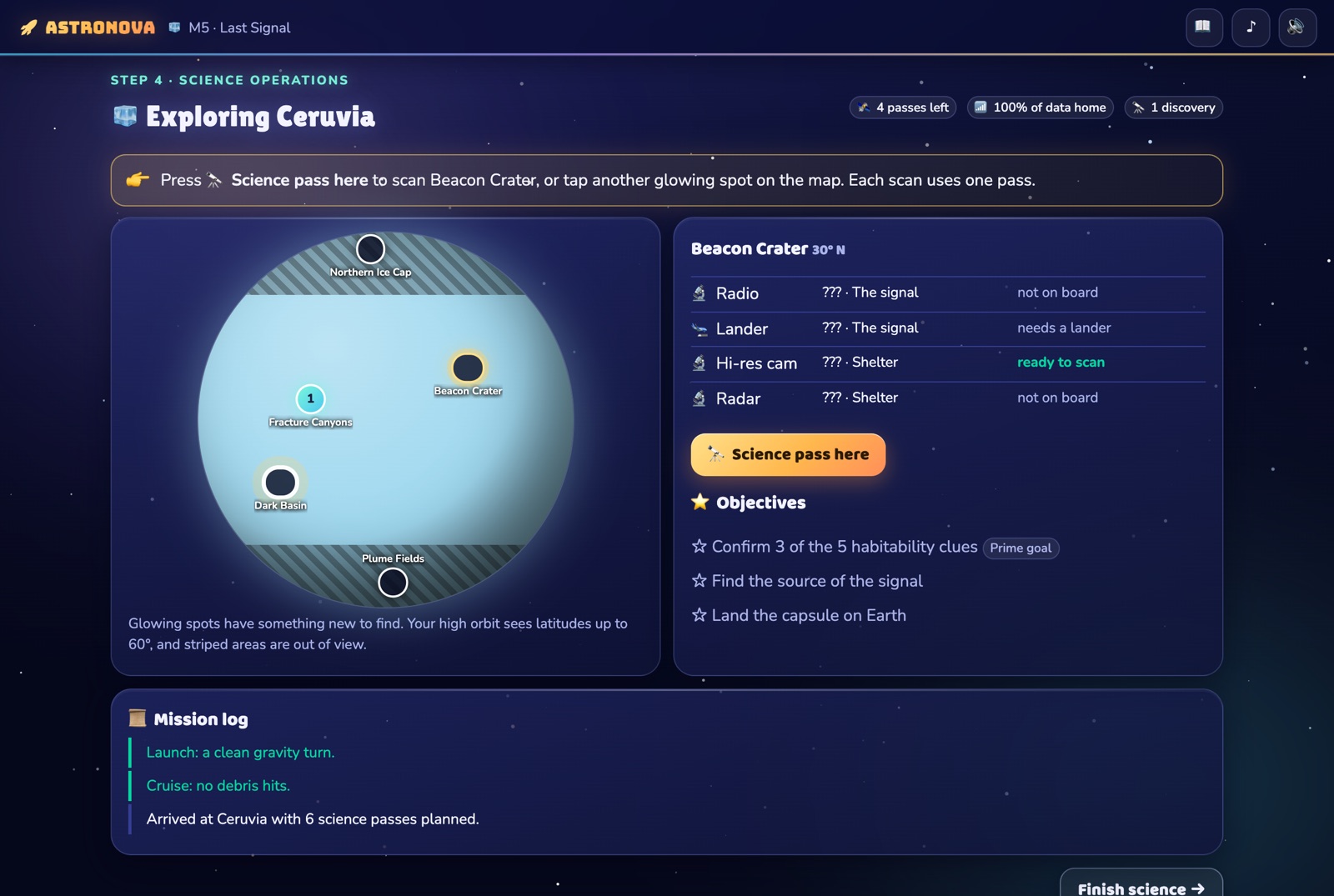
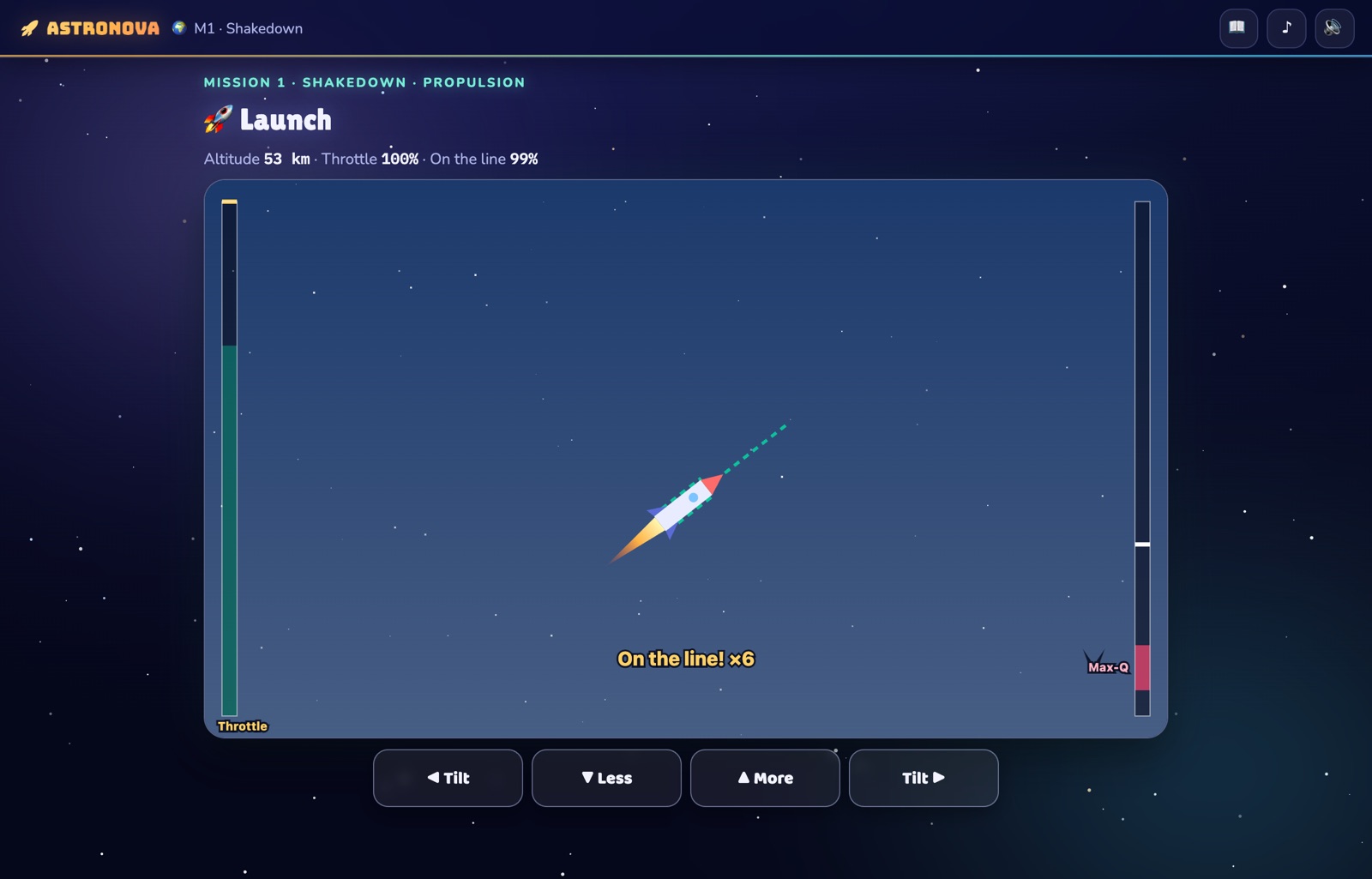
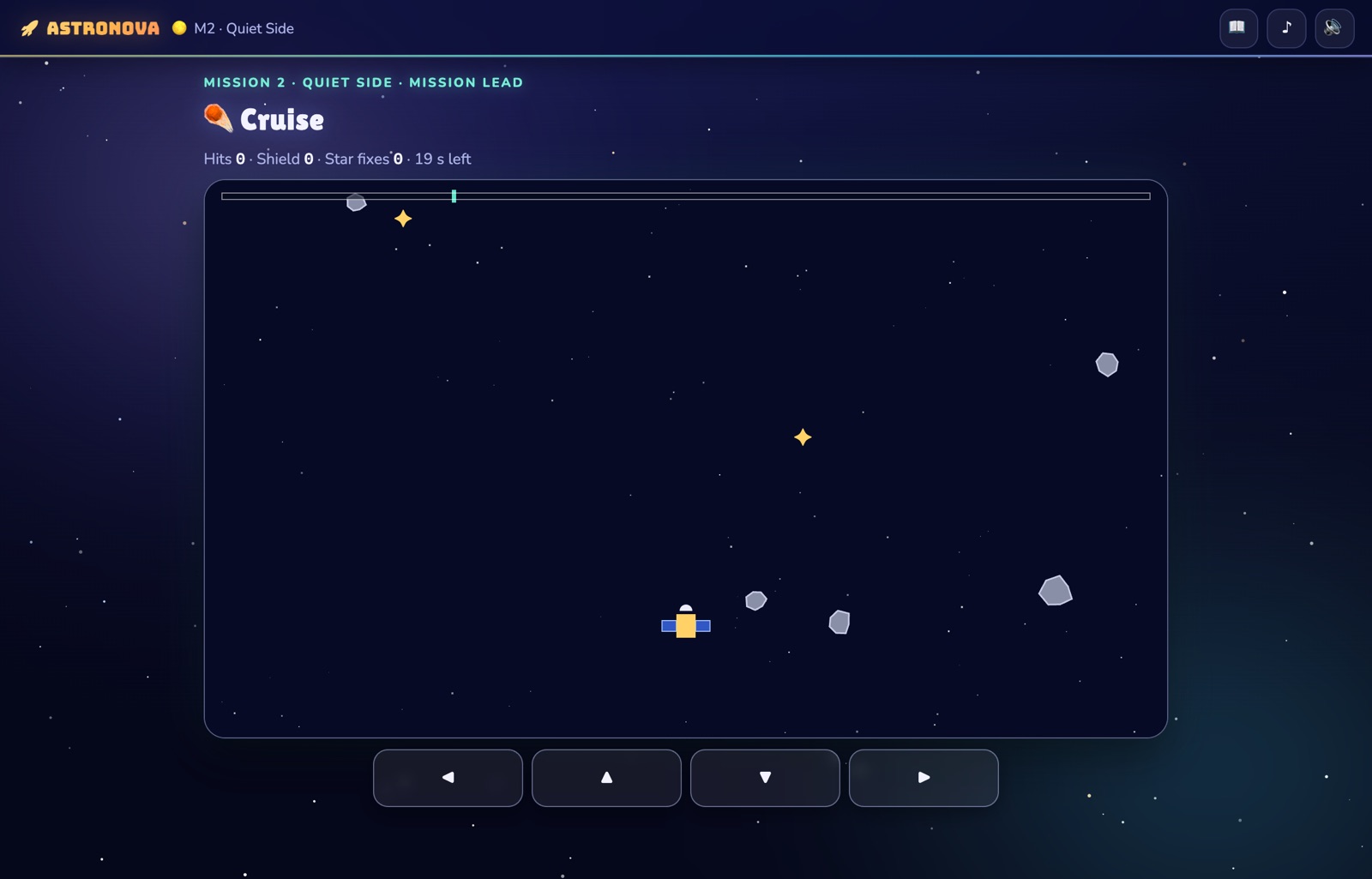
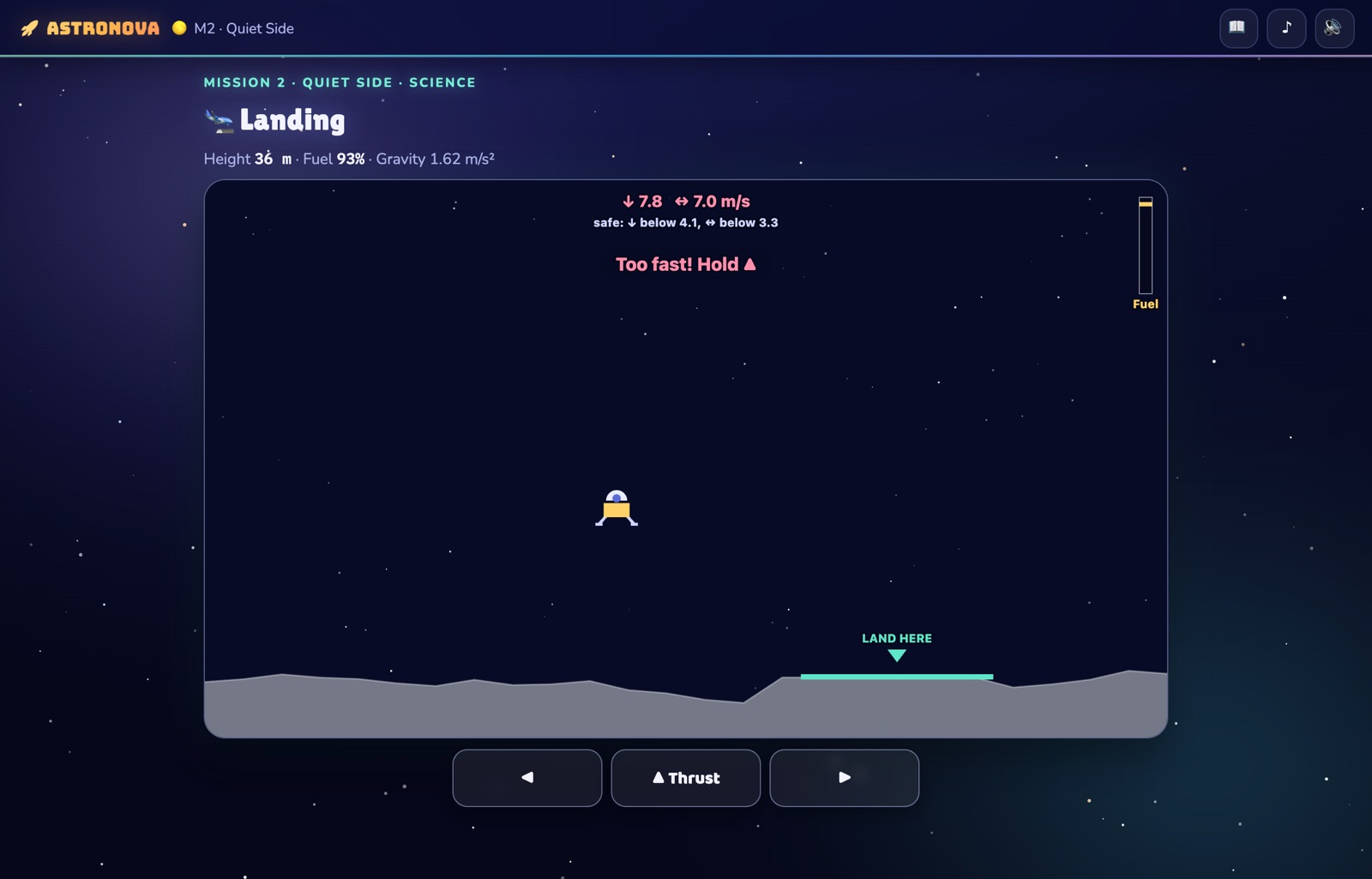
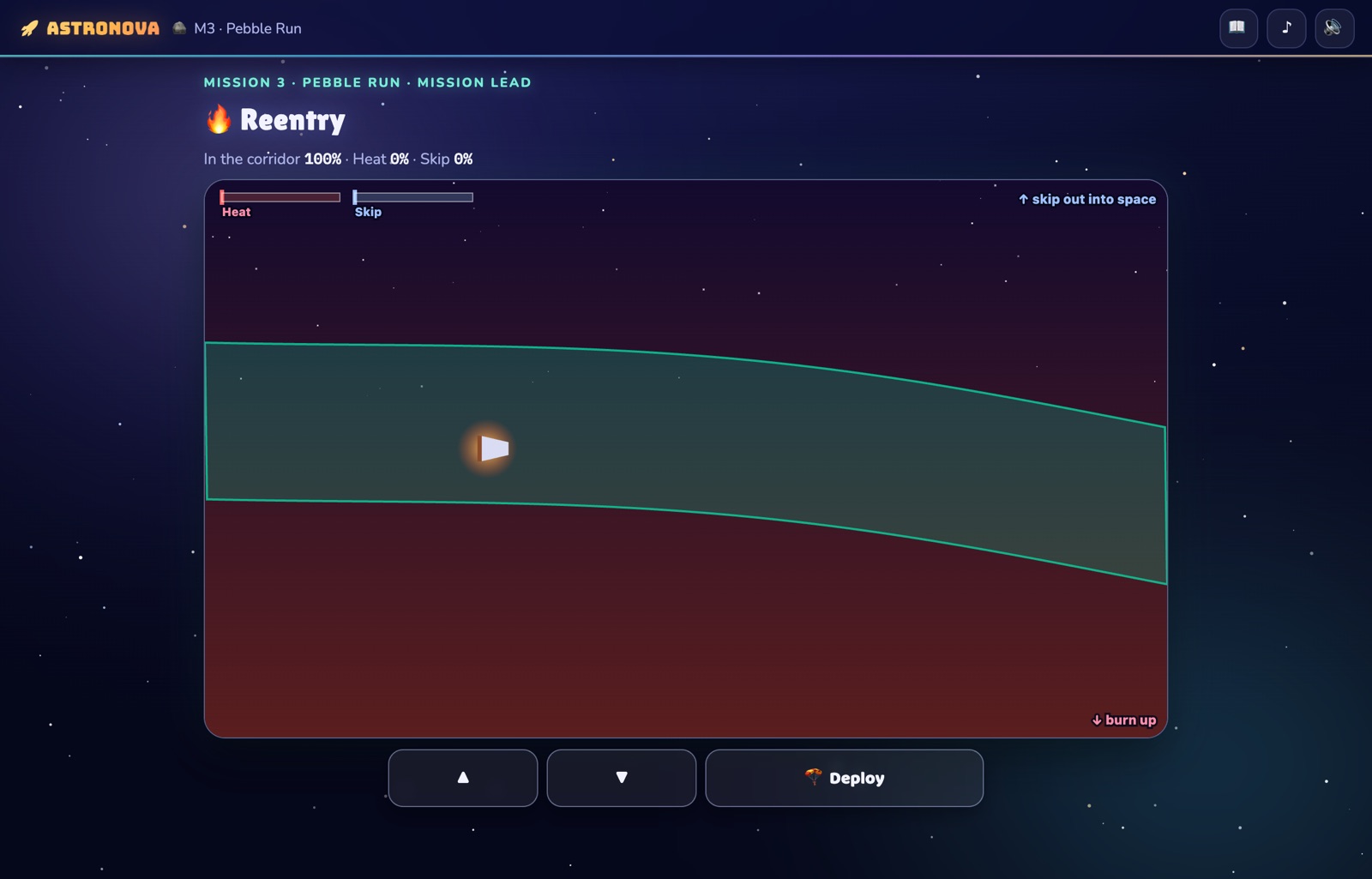
- Launch, debris field, orbit insertion, landing, touch-and-go and reentry.
- Your design changes the flight: heavy craft steer slowly, shields soak up hits.
- Choose where to scan, survive a power emergency, then read a report with real missions like yours.
- Co-op for 2–4 players with crew roles and a GO / NO GO vote.
ASTRONOVA
5 / 7
NASA data and resources
Built on how NASA plans missions
Design & Develop Science MissionsScience goal first; the review is split into launch, space, ground and user segments.
JPL Concept Maturity LevelsThe phase bar from idea (CML 1) to point design (CML 4).
Goddard Mission Design LabA trade study comparing up to three designs.
GMAT & Mission VizRocket equation, mission timeline and trajectory diagrams.
Webb "Build It Yourself"Goals show who uses the data; real missions like yours.
CubeSat 101 · CSA gamesSmall-sat power and data budgets; a beginner-friendly tone.
Real physics, simplified: the Tsiolkovsky rocket equation, inverse-square sunlight, RTG decay and orbital shadow. Facts from 14 real missions, including Landsat 9, OSIRIS-REx, Perseverance and Europa Clipper.
ASTRONOVA
6 / 7
Impact and what's next
Every student can be a mission designer
- Learn by doing: trade-offs become choices you feel, not formulas you memorise.
- For everyone: plain language, a coach, autopilots, keyboard or touch.
- Open: Apache-2.0, plain HTML, CSS and JavaScript, nothing to install.
- Next: a classroom mode, more targets (Europa, Titan) and real ephemeris data for trajectories.
▶ Play: saket-vanga.github.io/astronova Code: github.com/saket-vanga/astronova
Code, in-game text and synthesized audio were written with the help of Claude (Anthropic), directed and reviewed by the team. No AI-generated images. Not affiliated with or endorsed by NASA.
ASTRONOVA
7 / 7